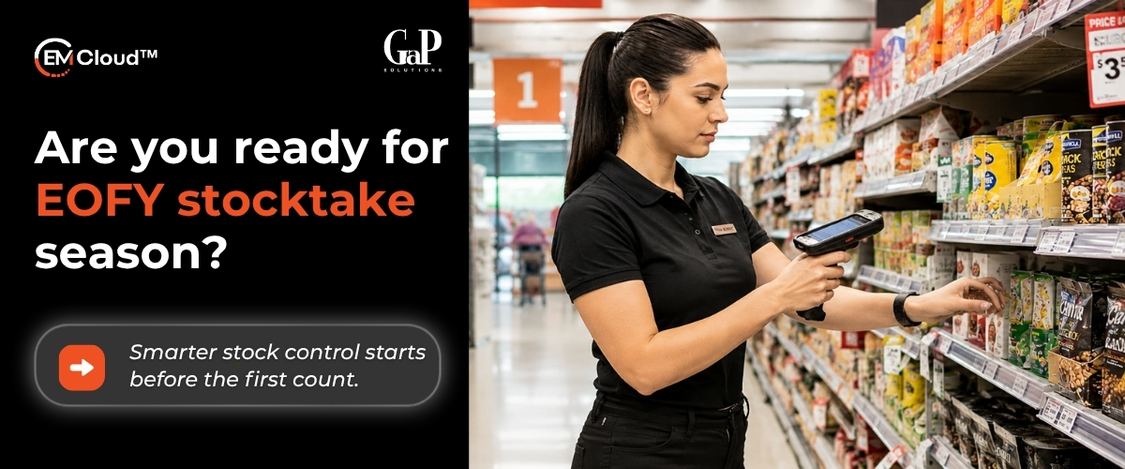
Are you ready for the EOFY stocktake season?
EOFY places extra pressure on retail teams. Supplier invoices, stock movements, pricing changes, reporting and daily trade all compete for attention in the weeks leading up to 30 June.
For grocery, fuel, liquor, bakery, butcher, seafood and multi-store retailers, a well-planned EOFY stocktake can do more than confirm stock on hand. It can improve inventory accuracy, highlight stock issues, support better ordering and help protect margins.
That is why the stocktake season should not feel like a last-minute rush.
With the right preparation and retail stock control tools, your team can approach EOFY with greater confidence.
Why stocktake preparation matters for retailers
A stocktake helps your team compare the stock physically in your business with the stock recorded in your system.
The ATO states that businesses must undertake a stocktake as close as possible to the end of each income year. The ATO also notes that simplified trading stock rules may apply where the change in the value of trading stock is no more than $5,000.
However, stocktake preparation matters beyond tax time.
Accurate stock data helps retailers make better decisions across ordering, pricing, promotions, supplier management, shrinkage control and reporting.
In practical terms, better stock visibility helps your team answer important questions:
- What stock do we actually have?
- What needs to be reordered?
- What is not selling?
- What stock may be affecting the margin?
- What products need to be corrected, deleted or reviewed?
For busy retailers, these answers can improve everyday operations long after EOFY ends.
Start with clean product data
A smoother retail stocktake starts with clean product data.
Before counting begins, review your product file to ensure key product details are accurate. This includes product descriptions, barcodes, departments, supplier links, pack sizes, cost information and retail pricing.
A small product file issue can slow down the entire stocktake process. For example, an incorrect barcode, an outdated product description or an inactive line can create confusion for the team during counting.
Clean product data gives your team a stronger starting point. It also helps reduce rework once the count has finished.
Review slow-moving stock before EOFY
Slow-moving stock can quietly affect cash flow, shelf space and margin.
Before EOFY, review products that have not moved as expected. This gives your team time to make practical decisions before the count begins.
You may need to:
- Mark down selected products
- Review product ranging
- Reduce future ordering
- Speak with suppliers
- Clear discontinued lines
- Investigate why the product is not selling
For fresh-food departments, bakeries, butchers, and seafood retailers, slow-moving stock can also increase waste. As a result, reviewing these lines before EOFY can support both stock accuracy and better department performance.
Use no-scan reports to find stock issues early
No-scan reports can help retailers identify products that have not moved through the point of sale as expected.
A no-scan product may point to a barcode issue, ranging problem, incorrect stock record, damaged stock, poor product placement or low customer demand.
By reviewing no-scan items before the stocktake, your team can find issues early and take action before EOFY reporting begins.
This step becomes especially important in high-volume retail environments where small stock issues can easily go unnoticed during daily trade.
Check supplier invoices and cost changes
Supplier invoices can affect stock accuracy, costing and retail margin.
If your team misses a supplier cost change or invoice variance, that issue can flow into pricing, reporting and margin management.
That is why invoice checking should form part of your EOFY stocktake preparation.
With EM Invoicing, supplier invoices can be emailed or scanned and then imported into EM Cloud™. Your team can then match invoices against received quantities and costing.
EM Cloud™ helps your team review:
- Quantity variances
- Supplier cost changes
- Invoice discrepancies
- Retail price impacts
- Margin considerations
This process helps retailers reduce manual invoice processing while improving visibility into the costs that affect stock and margins.
Protect your margins with better stock visibility
Margin control depends on accurate information.
A product may continue to sell well, but if supplier costs have increased and your team has not reviewed the retail price, the product may no longer deliver the expected margin.
In addition, stock discrepancies can make margin reporting harder to trust.
Better inventory accuracy gives retailers more confidence when reviewing pricing, promotions and supplier costs.
For this reason, stock control, invoice visibility and margin management should work together.
Prepare your team before the first count
Business.gov.au recommends planning your stocktake before you start, ensuring employees know what to count, choosing the right time, and having a supervisor at each stocktake location.
Your team should know:
- Which areas do they need to count
- Which devices or tools do they need to use
- How to handle products that do not scan
- How to report discrepancies
- Who will approve corrections
- When the count must be completed
A short team briefing can reduce confusion and improve consistency.
Most importantly, prepare early. Last-minute training can create unnecessary pressure during an already busy period.
How EM Cloud™ supports retail stock control
EM Cloud™ helps retailers manage key operational workflows across point-of-sale, stock control, invoicing, reporting, and pricing.
During stocktake season, EM Cloud™ can provide better visibility into product data, stock movements, reporting, and related back-office processes.
For grocery, fuel, liquor, bakery, butcher, seafood and multi-store retailers, this creates a more connected approach to retail inventory management.
Instead of treating stocktake as an isolated task, your team can use it as part of a broader stock control process.
EOFY stocktake checklist for retailers
Use this retail stocktake checklist before EOFY:
- Review product file accuracy
- Check barcodes and product descriptions
- Review deleted or inactive lines
- Investigate slow-moving stock
- Review no-scan products
- Check supplier invoice variances
- Review cost changes
- Assess retail price and margin impact
- Confirm stocktake devices are ready
- Brief your team before counting begins
This checklist gives your team a practical starting point and helps reduce pressure during the EOFY period.
Get ready before the EOFY rush
EOFY stocktake season does not need to become a last-minute scramble.
With clean product data, better invoice visibility, clear team processes and the right stock control software, retailers can approach EOFY with greater confidence.
GaP Solutions helps retailers improve stock visibility, reduce manual work and manage everyday retail operations through EM Cloud™.
Speak to the GaP Solutions team about EM Cloud™ stock control, EM Invoicing and the tools available to support your store this stocktake season.
Need help preparing for EOFY stocktake? Contact GaP Solutions today.